

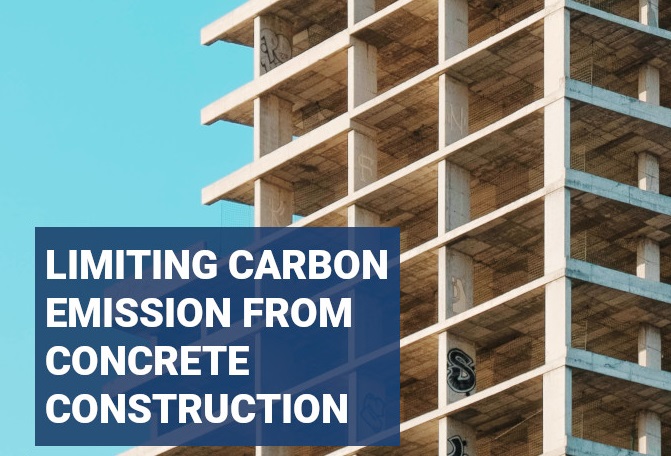
Concrete is one of the most widely used construction materials in the world. This is not surprising because the concrete offers a number of benefits such as strength, durability, versatility, fire resistance, and ease of construction.
However, concrete construction also has its downsides, and one of them is its adverse impact on the environment. One of the key concrete components; cement, contributes about 30% of carbon emissions from construction materials. Carbon emission into the environment is associated with a number of bad things such as global warming, acidification of oceans, disruption of ecosystems, and extreme weather events such as droughts.
According to the Emission Gap Report (2022) by the UNEP, one of the essential steps to limit carbon emission from the building sector is to reduce on emissions from construction. Limiting the carbon emission from concrete construction requires a good understand of the variables that affect the size of carbon emission from concrete. Research shows that these variables include scope, time, cost, quality, source, procurement, and project communication.
To simplify things, below are some simple steps to take in order to limit carbon emissions on your project.
How to Limit Carbon Emissions from Concrete Construction
- Project management
The first step to limit your project’s carbon emission is a lifecyle assessement. A lifecycle assessment will provide an understanding of the carbon footprint of your project, and help you set carbon emission reduction targets.
Secondly it is important to ensure collaboration between stakeholders within the project to meet these targets. This will require you to employ to your project management skills and tools.
You should also ensure that you have sustainable procurement on your project. By doing this, you will ensure that you deal with suppliers and contractors that have environmental friendly practices and offer low-carbon materials.
- Project Design and Planning
During the design of your project, you should prioritize low carbon materials as options for construction. Examples of such materials include hempcrete and recycled materials. For more about low carbon materials, you read our article on 8 alternatives to concrete.
You also need to look for designs that create enery efficiency and durability while also minimising the overall concrete requirements on the project. By creating durable and efficient structural designs, you limit on the maintenance needs and concrete materials used to repair or rennovate structures.
- Recycling and reuse materials
During construction, it is crucial to implement on-site material reuse and recycling to minimize the need for producing new concrete, which in turn reduces carbon emissions.
By efficiently managing construction waste and incorporating recycled materials, you can contribute to a more sustainable and environmentally responsible building process.
References:
Allwood, Julian & Cullen, Jonathan. (2009). Steel, aluminium and carbon: alternative strategies for meeting the 2050 carbon emission targets.
Huang, Beijia & Gao, Xiaofeng & Xu, Xiaozhen & Song, Jialing & Geng, Yong & Sarkis, Joseph & Fishman, Tomer & Kua, Harn & Nakatani, Jun. (2020). A Life Cycle Thinking Framework to Mitigate the Environmental Impact of Building Materials. One Earth. 3. 10.1016/j.oneear.2020.10.010.
Hermawan, Marzuki, P. F., Abduh, M., & Driejana, R. (2015). Identification of source factors of carbon dioxide (CO2) emissions in concreting of reinforced concrete. Procedia Engineering, 125, 692-698. https://doi.org/10.1016/j.proeng.2015.11.107
United Nations Environment Programme (2022). Emissions Gap Report 2022: The Closing Window — Climate crisis calls
for rapid transformation of societies. Nairobi. https://www.unep.org/emissions-gap-report-2022
For more updates, like our Facebook Page.
Please don’t forget to subscribe to our newsletter!
YOU MAY ALSO LIKE TO READ
- A Simple Guide to Runoff ManagementWhether you are working on a small infrastructure project or a large one, rainwater (runoff) is always going to be an issue. That’s why runoff management is a critical part of sustainable land development and environmental protection. As more parts of the world become urbanized and climate patterns continue to… Read more: A Simple Guide to Runoff Management
- A Billion Dollar Problem: What Construction Waste Management Means for the IndustryIt is estimated that nearly 30% of the world’s solid waste comes from construction and demolition (C&D) activities. This includes everything from broken concrete, wood, metal, drywall, bricks, glass, plastics, asphalt, to packaging materials. Most of this waste ends up in landfills, contributing to environmental degradation and increasing costs for… Read more: A Billion Dollar Problem: What Construction Waste Management Means for the Industry
- 5000 Years of Computing: Our Engineering Journey to Quantum ComputingFor over a millennium, human ingenuity has been entwined with the development of tools to aid computation. From the use of the abacus beads to the barely comprehensible entanglement of quantum bits, computing has evolved not only in speed and complexity but also in the way engineers use it to… Read more: 5000 Years of Computing: Our Engineering Journey to Quantum Computing